Skip to content


Design Backwards: When the Material Inventory Becomes the Brief
The Regenerative Strategist
Welcome and thank you for reading The Regenerative Strategist. A weekly update on harnessing the power of decarbonization, digitization, and enhanced data collection, delivering buildings of the future powered by renewable energy & automation.
Want to stay informed?
Subscribe to this series using the button above and let us know what you want to hear about next week using #UrbanAO in the comments below.
Introduction
Here is the inversion that should fundamentally reshape how every architect, engineer, and developer approaches the next project
🔄 For a century, design has followed this sequence: dream → specify → procure → build. Now, the most advanced practices are reversing the arrow: inventory → compute → adapt → assemble.
📐 Computational methods can achieve near-optimal material utilization (within 10% of theoretical maximum efficiency) in minutes, enabling real-time design space exploration.
🌍 Inventory-first design delivers 50-80% lower environmental impact than minimum-weight new-element structures while accepting just 10-30% structural over-capacity, shifting the optimization paradigm from minimum-weight to minimum-carbon.
💰 $600 billion in materials will be available from retrofits in 2050 alone, creating an unprecedented stock for reuse-driven design and localizing material flows at urban scale.
Architecture has historically assumed infinite material availability at predictable costs. That assumption is collapsing under the weight of planetary boundaries, supply chain fragility, and embodied carbon regulation. The result is a profound inversion: from “form follows function” to “form follows availability.”
This is not a call to aesthetic compromise. It is a recognition that constraints—budget, site, gravity—have always been the engine of architectural creativity. Legendary architects from Louis Kahn to Carlo Scarpa built masterpieces by working within material and financial limits, not despite them. Inventory-first design adds material scarcity as a generative force, treating salvaged components not as a limitation but as a design accelerant. When architects stop asking “what material catalog offers the ideal section?” and instead ask “what forms can emerge from this inventory of available stock?”, design becomes simultaneously more constrained and more creative.
Between 2021 and 2025, researchers at MIT, ETH Zurich, EPFL, and leading architecture practices have developed algorithmic methods that enable real-time design space exploration driven by available stock rather than virgin material catalogs. Computational tools now match thousands of irregular salvaged elements to parametric structural systems in seconds, optimize cutting patterns to minimize waste within 4-12 meters of theoretical maximum efficiency, and guide robotic fabrication of bespoke connectors for non-standard geometries. Built projects validate the approach: the Triodos Bank headquarters in the Netherlands was conceived as a fully demountable “material bank,” using 165,312 high-quality bolts (zero welding/gluing) and comprehensive digital passports for every component. JAJA Architects transformed 1960s prefab housing blocks into material banks for new construction, achieving significant CO₂ savings through localized circular economies
This edition explores the inventory-first paradigm across four dimensions, each representing a critical piece of the transformation:
1️⃣ The Logic Inversion – how design methodology must reverse from brief-driven to inventory-driven workflows.
2️⃣ Algorithms for Adaptation – the computational methods and optimization strategies matching salvage to structure in real time.
3️⃣ Digital Infrastructure – the technology stack enabling urban-scale material detection, cataloguing, and traceability.
4️⃣ Built Validation – completed and in-progress projects proving inventory-first design is viable, financeable, and architecturally ambitious.

I. The Logic Inversion: From Brief to Inventory
1. The Conventional Sequence and Its Cascading Limits 📉
Traditional practice follows a rigid, linear sequence largely unchanged since the 19th century: Design → Specify → Procure → Build.
This model treats materials as a downstream consequence of form, assuming infinite availability at predictable costs. The results are stark:
Waste Generation: 15–25% of delivered materials become construction waste due to cuts and errors.
Regulatory pressure is now forcing a pivot. With six of nine planetary boundaries breached, the EU’s Digital Product Passport (2026) and France’s life-cycle mandates (2025) are making linear “take-make-waste” workflows legally obsolete.
2. The Inverted Workflow: From Inventory to Design
🔄 Inventory-first design reverses the arrow entirely: Inventory → Compute → Adapt → Assemble.
-
Inventory Detection 🕵️♂️: Treat demolition sites as “material revelation sites.” Use computer vision and ML to rapidly catalogue geometry and structural capacity.
-
Computational Matching 🧩: Algorithms search design spaces to maximize stock utilization and minimize waste, ensuring geometric fit.
-
Adaptive Generation 🧬: Design becomes generative, not prescriptive. Parametric models adjust form and topology to fit the available inventory constraints.
-
Precision Fabrication 🤖: Robotic/CNC processing creates bespoke joints for irregular reclaimed elements, ensuring zero-waste assembly.
As EPFL’s Structural Xploration Lab states: “Form follows availability.” When scarcity is embraced as a driver, constraints fuel innovation rather than limit it.
3. Two Strategic Computational Approaches 🧮
Research identifies two primary strategies for matching salvage to structure:
-
Bottom-Up (Inventory → Design) 🏗️: Algorithms assemble available components into structures.
-
Strength: Guaranteed geometric fit; mirrors physical assembly.
-
Challenge: Hard to control formal expression; risks aesthetic randomness without strong guidance.
-
-
Top-Down (Target Design → Inventory Search) 🎯: Starts with a design intent and searches inventory to match parts.
-
Strength: Preserves architectural vision; supports multi-objective optimization.
-
Challenge: Computationally expensive; usually requires some material processing.
-
Hybrid methods are emerging as the winner: define high-level goals (floor area, typology), then let algorithms generate a Pareto front of variants optimized for the stock at hand.
4. Why Now? Convergence of Four Structural Drivers 🚀
Planetary Pressure 🌍: Circular pathways could abate 4.15 Gt CO₂ by 2050—equivalent to 14x France’s annual emissions.
Embodied Carbon: 11% of global emissions are locked in materials, with the built environment driving 40% of total GHGs.
Fragility: 40% of projects face supply chain delays as global logistics fracture.
Economic Opportunity 💰: The circular construction economy is a $4.5 trillion opportunity. By 2050, recirculating retrofit materials represents a $600 billion market alone.
Resilience 🛡️: With 40% of projects delayed by supply chains, localized urban mining buffers against global volatility.
Digital Maturity 💾: Machine learning now classifies waste with 92.3% accuracy, while algorithms match millions of parts in seconds. These tools simply didn’t exist at scale five years ago.

II. Algorithms for Adaptation: The Computational Toolkit
Inventory-first design is fundamentally a combinatorial optimization problem: 🧩 Given a pile of unique, non-standard parts, how do we compute a structure that is safe, useful, and minimally wasteful?
1. The Algorithmic Landscape 🤖
Different tools solve different scales of this puzzle:
-
Hungarian Algorithm: The speed demon. 🏎️ It achieves globally optimal one-to-one matching (one beam → one slot) in real-time for small inventories (~200 items). Its flaw? It can’t handle cutting or processing.
-
Integer Linear Programming (ILP): The strategist. 🧠 It solves one-to-many cutting-stock problems (one long beam → multiple short parts) and handles complex fabrication constraints like tool changes. The cost is time—it takes minutes, not seconds.
-
Mixed Integer Linear Programming (MILP): The rigorous hybrid. ⚖️ Perfect for mixing reused and new elements with proven mathematical optimality, though computationally heavy.
-
Genetic Algorithms (GA): The explorer. 🧬 Great for navigating messy, non-convex design spaces. They evolve populations of designs to find surprising solutions that rigid formulas might miss.
2. Case Study: MIT Geodesic Dome Tool (2021) 🏚️➡️🌐
The Challenge: Turn a suburban house’s ~200 disparate timber members into a new structure instead of landfill.
The Workflow:
-
Digitize: Scan every joist and rafter into a library of available parts. 📏
-
Parameterize: Generate geodesic dome geometries (radius, frequency).
-
Compute Cost: Calculate mismatches in length and load capacity for every potential beam-to-slot pairing.
-
Optimize: Use the Hungarian Algorithm for instant, optimal assignment, then refine dome geometry to minimize waste.
Results: Real-time feedback allowed architects to see trade-offs instantly—larger domes used more stock but created more waste; smaller domes were efficient but less functional. Physical prototypes proved it worked. ✅
3. Case Study: ETH Zurich Dome 5.1 & 5.2 (2024) 🇨🇭
Building on MIT, ETH Zurich tackled a harder problem: disassembling two real buildings to build domes with cutting-stock optimization.
Advances:
-
One-to-Many Optimization: Instead of 1:1 matching, algorithms cut long salvaged beams into multiple target parts, boosting utilization but increasing complexity to NP-hard levels. ✂️
-
Real-World Constraints: The code accounted for saw kerf, tool changes, and even a ±10% margin of error for inventory surprises.
-
Performance: The system achieved 94-95% material utilization (within 4-12m of theoretical max efficiency).
Physical Outcomes: 🏗️ CNC-milled connectors joined salvaged elements, guided by HoloLens 2 AR headsets that color-coded assembly steps in real-time.
4. Case Study: EPFL “Form Follows Availability” (2019-2021) 📐
EPFL asked a radical question: What if the material invents the form?
Two Scenarios:
-
Reuse from Stock: You have a pile of junk. The algorithm grows the optimal shape to use it.
-
Design of Kits: You have three future buildings. The algorithm designs a universal “kit of parts” that works for all three to maximize reuse cycles. 🔄
Key Findings:
-
Site-Specificity: Different trash piles create radically different buildings. Global standardization is out; hyper-local adaptation is in.
-
The Weight Trade-off: Reuse structures are often 10-30% heavier than new ones (oversized beams).
-
The Carbon Win: Despite being heavier, they have 50-80% lower environmental impact. The embodied carbon savings crush the efficiency penalty. 🌍📉

III. Digital Infrastructure: Making Inventory-First Design Scalable
Inventory-first design cannot function without robust digital infrastructure spanning detection → cataloguing → optimization → fabrication → tracking. This “technology stack” is rapidly maturing.
1. Urban-Scale Material Mapping: Finding Hidden Resources
The Challenge: Before deconstruction or retrofit begins, how do cities identify which buildings contain high-value reusable materials? Traditional approaches rely on manual surveys by contractors—slow, expensive, and often incomplete.
The ETH Zurich Approach (2024): Researchers combined Computer Vision + Machine Learning applied to Google Street View imagery, integrated with cadastral data (building age, typology, permit records). Using linear regression, random forest, and extreme gradient boosting models, they trained algorithms to predict material quantities (concrete, steel, timber, glass) at city scale based on visual and historical data alone—no site visits required.
Outcome: Analyzed 409 buildings in Zurich. The resulting material stock maps visualized spatial concentration of reusable resources, enabling strategic deconstruction planning—prioritizing high-value stocks near active construction sites to minimize transport distances and storage times. This is the foundational step enabling circular urban economies: converting invisible inventory into visible, mappable assets.
2. Scan-to-Inventory Automation: Cataloguing at Scale
The Challenge: Deconstruction generates thousands of components. Manually measuring and cataloguing each item is prohibitively expensive and slow. Yet without precise dimensional data, computational matching is impossible.
Technology Stack: Reality capture via photogrammetry (Agisoft Metashape, COLMAP), terrestrial LiDAR, mobile-phone LiDAR, and drones. Scan-to-BIM workflows convert point clouds into structured 3D models with semantic labeling (this section is concrete, this is steel reinforcement, this is timber). Computer Vision techniques (PointNet, convolutional neural networks, support vector machines) automatically classify and measure components.
ETH K118 Halle Study (2024): When scanning a complex former industrial hall for deconstruction, researchers compared photogrammetry versus mobile LiDAR. Photogrammetry outperformed LiDAR for steel structures (dense point clouds, lower noise). Computer vision achieved 0.78 accuracy for interior material classification despite poor lighting, occlusion, and visual clutter typical of demolished buildings. The output: BIM models with embedded material passports containing geometry, structural properties, embodied carbon, and condition grade.
3. Material Passports and Blockchain Tracking: Encoding Material Value
The Challenge: Materials removed during retrofit/deconstruction lose their identity. Without documentation, they become indistinguishable commodities rather than tracked assets. Matching supply (material removed in city A) with demand (material needed in city B) requires transparent, verifiable data.
Emerging Standards: Recent work synthesizes eight key recommendations for material passport adoption:
For existing buildings: (1) Prioritize reuse of whole buildings, (2) Conduct pre-demolition audits, (3) Prefer deconstruction over demolition, (4) Prepare detailed deconstruction plans.
For system standardization: (5) Establish clear standards for data formats and interoperability between databases, (6) Produce passports linked to lifecycle phase (existing, proposed, completed), (7) Use consistent classification systems (e.g., Uniclass), (8) Integrate passports with BIM for spatial analysis.
Enabling Technologies: Digital Product Passports (DPPs) use QR codes and RFID chips embedding material data (composition, origin, carbon footprint, recyclability). Blockchain provides distributed ledgers for transparent provenance tracking across multiple ownership cycles. BIM-linked passports allow planners to generate building circularity assessments with a single click, iterate on product selection until performance targets are met.
The Triodos Bank Example: The headquarters in Zeist, Netherlands, integrates comprehensive material passports for 165,312 bolts and all major timber/concrete/steel components via the Madaster platform. Every component has documented origin, composition, quantity, and future reuse potential. This enables proactive listing of components on secondary markets years before disassembly.
4. Generative AI and Computational Design Integration
Current State (2024-2025): Text-to-image generative AI (RunwayML, Midjourney) can produce conceptual inspiration—”a geodesic dome made from reclaimed warehouse beams in a forest setting” generates evocative imagery. Limitation: Outputs are 2D images, not structurally viable, and lack material passport integration.
Future Direction: 3D generative models (neural radiance fields, diffusion models trained on BIM libraries plus structural constraints) could produce viable spatial outputs with embedded material compatibility.
Integration Workflow: (1) Disassembly → scan → material passport database. (2) Designer defines functional goals (floor area, height, structural type). (3) Computational tool queries database → generates design variants balancing material utilization, waste, cost, structural performance, aesthetic preferences. (4) Export fabrication files (CNC toolpaths, assembly instructions).
Performance: ILP optimization for ETH Dome 5.1/5.2 completed in minutes on standard workstations; iterative design-space exploration enabled same-day design cycles and interactive designer feedback.
5. XR-Guided Assembly and Robotic Fabrication
Extended Reality (XR) Assembly Guidance: Microsoft HoloLens 2 with Unity3D engine overlays a 1:1 3D model onto physical space with transparency. A color-coded system highlights the next component to install (temporal sequence) and exact mounting location (spatial precision). Benefits: reduced manual errors, faster assembly, enabling semi-skilled workers to execute complex reuse projects.
Robotic Fabrication: CNC machines mill bespoke connectors from salvaged OSB plates, accommodating non-standard dimensions of reclaimed water pipes with ±2mm tolerances for timber joinery. Robotic additive joining (welding) creates unique beam connections, enabling tailored component interfaces for irregular geometries.
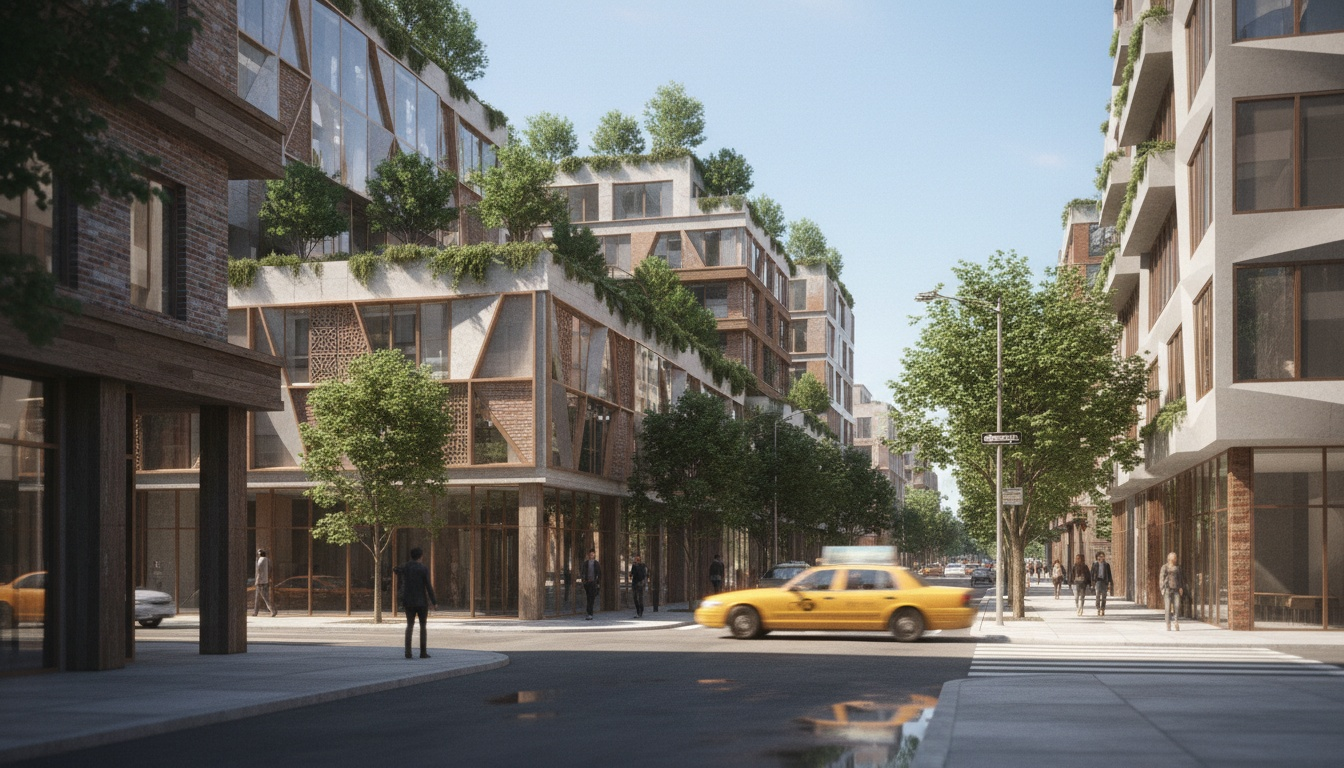
IV. Built Validation: From Research to Reality
While computational research has advanced rapidly, built validation at architectural scale remains essential for proving viability, securing financing, and shifting professional practice norms.
1. Triodos Bank Headquarters, Zeist, Netherlands (2019)
Architect: RAU Architecten
Designation: World’s first fully demountable bank building with comprehensive material passport. Every bolt is reversible; zero permanent adhesives or welding.
Design Philosophy: The building is conceived not as a destination but as a temporary configuration—a “material depot” storing high-quality components for future redeployment. Over 50+ years of occupancy, components can be repaired, replaced, or redistributed to other projects without demolition.
Specification: 5 stories, 12,994 m² gross floor area. 1,615 m³ of glued laminated timber (GLT), 1,008 m³ of cross-laminated timber (CLT), and 5 whole tree trunks as sculptural elements. The footprint is amoeba-shaped, designed through computational optimization balancing formal expression with structural efficiency. The facade grid uses 3.60m modules—a dimension not arbitrary but derived from available CLT plate sizes, demonstrating how inventory-first thinking permeates even large architectural gestures.
Inventory-First Methodology: Timber dimensions were dictated by available GLT/CLT production sizes (a stock constraint). Bolted connections were designed for reversibility, explicitly enabling future disassembly. The material passport in Madaster documents every component, enabling proactive matching to future projects needing similar timber sections.
Outcomes: Won architecture and sustainability awards (2020-2021). Triodos, the client, specifically values residual material value of investments—the building will retain monetary and environmental value even after its original programmatic purpose expires. This represents a fundamental business-model shift: treating buildings as temporary configurations rather than permanent artifacts.
2. JAJA Architects: Ressource Blokken, Denmark (2023)
Challenge: Transform 1960s-70s prefabricated residential blocks (aging, inefficient) into material banks for new housing while preserving affordability.
Strategy: Rather than demolish-and-replace, JAJA extracted room-sized prefab modules and smaller components (wall elements, hollow-core floor slabs, windows, doors) from the original blocks. These were combined with new timber roof and facade elements, creating hybrid assemblies. Materials were reused locally, minimizing transportation embodied carbon and supporting neighborhood-scale circular economies.
Material Outcomes: Hollow-core concrete floor slabs from the original structure became floor systems for new housing. Facade elements were repurposed. Copper piping and windows (valuable materials) were salvaged and reintegrated. Staircase elements from disassembly were creatively reused as bicycle parking, playground equipment, and outdoor fitness stations—demonstrating material intelligence at multiple scales (building + site + public realm).
LCA Results: Significant CO₂ savings compared to newly constructed homes with equivalent functionality, though exact percentages were not disclosed in published documentation.
Aesthetic Integration: The interior celebrates material provenance rather than hiding reuse. A central double-height space with skylights blends original concrete modules with light timber cladding. Recycled doors become closet walls. The aesthetic strategy is transparency rather than disguise—acknowledging the biography of materials and inviting residents to understand circular value.
3. IASS 2024 Case Study: Reuse-Constrained Structural Form-Finding (China)
Challenge: Disassemble an existing timber structure → computationally form-find a new design optimized for the available components.
Method: Vector-based Graphic Statics (VGS) integrated with BIM workflows. Input: Array of disassembled components with measured dimensions plus catalogued load capacities. The iterative process uses VGS to dynamically adjust structure form and force distribution, increasing the component fitting rate iteration by iteration. Design constraints maintain specific structural limits (allowable deflection, ultimate capacity).
Outcome: Feasibility demonstrated through physical construction. Real-world complexity was handled—variable component conditions (cracks, warping), multi-source inventories (mixing elements from multiple demolition sites). However, this was a single-source-to-single-design scenario; future work must address multi-source-to-multi-design (multiple demolition inventories → multiple active projects), which is more realistic for urban-scale material flows.
4. UIA 2026: Mineral Urban Mining Challenge in Barcelona
The UIA World Congress of Architects 2026 in Barcelona is dedicating a major initiative to “Mineral—Architectures of Urban Mining,” with a €336,000 budget to prototype and pilot circular-material strategies.
Winning Proposal 1—Spolia (Baukunst studio + Structural Xploration Lab, EPFL): Direct reuse of large mineral waste pieces—asphalt, concrete—without crushing or separation. Rather than grinding demolished concrete into undifferentiated aggregate, Spolia recomposes large chunks into large-format modular systems (retaining walls, infrastructural landscapes). This minimizes material processing, transport, and energy demand. Demolition rubble is reframed as prefabricated, large-format construction modules rather than waste requiring further processing.
Winning Proposal 2—Grounded Futures (BC Materials, BC Architects, BC Studies): Develops new building materials from crushed mineral waste combined with a natural seaweed-based binder. The team experiments with multiple product typologies (bricks, panels, plates) to reintroduce these composites into public spaces. The binder is entirely natural, removing polymer/synthetic content from the recycled material stream.
Implementation Timeline: Both projects undergo on-site pilots in Barcelona in 2026, monitored for at least one year before being showcased at the Congress exhibition. This creates a high visibility living lab for urban mining and circular construction, signaling that this is no longer speculative research but mainstream architectural discourse.

Conclusion: The Brief Becomes the Inventory
The inversion of architectural logic—from authoring form to adapting to availability—is not a retreat from design ambition but an expansion of it. Constraints have always been the engine of creativity: budget, site, gravity, client program. Legendary architects like Diébédo Francis Kéré design masterpieces with minimal resources because constraints force invention. Inventory-first design adds planetary boundaries to that list, treating material scarcity not as an obstacle but as a generative force.
The evidence is clear: Algorithms (Hungarian, ILP, genetic) achieve near-optimal material matching in seconds to minutes. Built projects (Triodos, JAJA, ETH Domes) validate structural performance, aesthetic quality, and lifecycle value. Digital infrastructure (scan-to-BIM, material passports, XR assembly) makes inventory-first workflows scalable. Economic drivers (carbon pricing, ESG mandates, supply chain fragility) align financial incentives with planetary imperatives.
Yet transformation is incomplete. Computational methods remain siloed in research labs; regulatory frameworks lag technology maturity; cultural inertia privileges newness over resourcefulness. The barriers are not technical—they are systemic, requiring coordinated reform across education, policy, finance, and culture.
The critical conceptual shift is this: Treat every demolition not as waste generation but as inventory revelation. Treat every design brief not as a blank slate but as a matching problem. Treat every building not as a monument but as a temporary material bank for future configurations.
The next decade will determine whether “form follows availability” becomes an architectural movement or remains a research footnote. The tools exist. The case studies validate. The climate crisis demands. The question is whether the profession has the collective will to invert 150 years of design practice, embracing scarcity as creativity’s truest condition. 🔄
The brief is no longer what the client wants. The brief is what the planet can provide. 🌍