
Beyond Concrete: The New Material Blueprint for a Resilient Planet
The Regenerative Strategist
Welcome and thank you for reading The Regenerative Strategist. A weekly update on harnessing the power of decarbonization, digitization, and enhanced data collection, delivering buildings of the future powered by renewable energy & automation.
Want to stay informed?
Subscribe to this series using the button above and let us know what you want to hear about next week using #UrbanAO in the comments below.
Introduction
Here is a figure that should fundamentally reshape our understanding of urban development: 40% of global greenhouse gas emissions originate from the built environment. While operational carbon – the energy used for heating, cooling, and power – accounts for 29%, a staggering 11% comes from embodied carbon. This is the hidden carbon footprint of our cities, locked into the very materials we use to build them. Every ton of steel and cubic meter of concrete comes with a heavy carbon price, together responsible for approximately 16% of all global emissions annually.
We are building our way into a climate crisis.
The paradox? The solutions are not waiting to be invented; they are already here, proven and performing in the real world. A comprehensive review of 275-300 operational projects built between 2019 and 2025 across every climate zone on Earth sends a clear message: the technical barriers to low-carbon, climate-adapted construction have been surmounted. We have materials that are not just less bad, but are actively regenerative, sequestering carbon and enhancing ecosystem health.
-
Embodied carbon reductions of 21-95% are not theoretical but have been achieved in practice.
-
Operational energy savings of 13-50% are being realized in validated, occupied buildings.
-
Construction is 10-40% faster thanks to prefabrication and advanced material systems.
The roadblocks are no longer scientific. They are economic, regulatory, and logistical. We face a 10-40% upfront cost premium, a 5–10-year regulatory lag, and a need to scale production by 50-500 times to meet mainstream demand.
The age of concrete and steel as default materials is over. A new era of building materials is emerging, one that demands a radical rethinking of our supply chains, financial models, and regulatory frameworks. The question is no longer if we can build a resilient, low-carbon world, but if we have the collective will to deploy the tools we already possess at the scale the climate crisis demands. 🌍🛠️
Four Critical Dimensions 📋
This analysis explores the new material blueprint for a resilient planet across four critical dimensions:
1️⃣ The Carbon Imperative: Deconstructing the hidden climate cost of conventional materials and quantifying the transformative potential of low-carbon alternatives.
2️⃣ The Bio-Based Revolution: A deep dive into the performance, applications, and carbon-negative potential of massive timber, hempcrete, mycelium composites, and bio-cements.
3️⃣ Climate-Specific Adaptation: How advanced materials are being deployed to create resilient buildings in the world’s most extreme climates, from Arctic permafrost to tropical humidity.
4️⃣ The Pathway to Scale: Unpacking the economic, policy, and market drivers needed to accelerate the global adoption of climate-resilient materials.
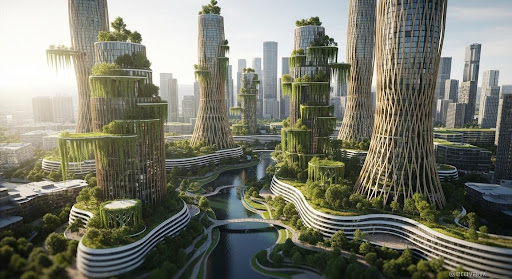
I. The Carbon Imperative: Deconstructing an Outdated Model
For over a century, the story of construction has been written in concrete and steel. These materials built our modern world, but they did so at a steep environmental cost. The chemistry of their production is inherently carbon-intensive, and their dominance has locked us into a high-emissions trajectory.
The Unseen Cost of Convention
-
Reinforced Concrete: The workhorse of modern construction, conventional concrete has an embodied carbon footprint of 850-1,100 kg of CO₂-equivalent per cubic meter (kg CO₂-eq/m³). The primary culprit is cement, whose production process, involving the high-temperature calcination of limestone, accounts for 50-70% of its total emissions. Globally, the cement industry alone is responsible for about 8% of all CO₂ emissions.
-
Steel: From skyscrapers to single-family homes, steel provides essential structural strength. Yet, primary steel production using a blast furnace generates 1,200-1,800 kg CO₂-eq/m³. This process is energy-intensive and reliant on coal, making it a major contributor to industrial emissions.
When scaled globally, the impact is staggering. A typical 1,000 m² residential building constructed with a conventional concrete and steel frame carries an embodied carbon load of approximately 332,500 kg of CO₂. Over a 50-year lifespan, when combined with operational emissions (assuming a grid carbon intensity of 0.2 kg CO₂/kWh and an energy use of 140 kWh/m²/year), the total carbon footprint reaches a massive 1,732,500 kg of CO₂. This is the baseline we must disrupt.
The Low-Carbon Alternative: A Paradigm Shift
The new generation of building materials offers a starkly different performance profile. By leveraging natural processes and advanced manufacturing, these materials fundamentally alter the carbon equation of construction.
| Material | Embodied Carbon (kg CO₂-eq/m³) | Key Process Emissions |
|---|---|---|
| Reinforced Concrete | 850-1,100 | Cement calcination (50-70% of total) |
| Steel (Primary) | 1,200-1,800 | Blast furnace reduction, electricity |
| CLT/Mass Timber | 350-700 | Sawmill energy, adhesives |
| Bio-Cement | 3-6 | Fermentation energy, bacterial cultivation |
| Hempcrete | -50 to -100 | Carbon sequestration > production emissions |
| Rammed Earth | 20-50 | Minimal processing; primarily transportation |
| Mycelium Composite | 0-50 | Agricultural waste valorization; minimal energy |
The contrast is dramatic. Materials like hempcrete are actively carbon-negative, sequestering more CO₂ during their growth cycle than is released during their production. Others, like bio-cement and mycelium composites, offer near-zero emissions by valorizing waste streams and relying on biological processes. Even mass timber, at 350-700 kg CO₂-eq/m³, represents a 60% reduction compared to a reinforced concrete baseline.
Applying this to our 1,000 m² building example, a switch to a CLT and passive design strategy yields:
-
Embodied Carbon: 150,000 kg CO₂ (55% reduction)
-
Operational Carbon: 900,000 kg CO₂ (36% reduction, assuming EUI drops to 90 kWh/m²/year)
-
Total Life-Cycle Carbon: 1,050,000 kg CO₂ (39% total reduction)
This isn’t just an incremental improvement; it’s a fundamental shift in the impact of construction. It proves that our buildings can be transformed from a carbon source to a carbon sink.
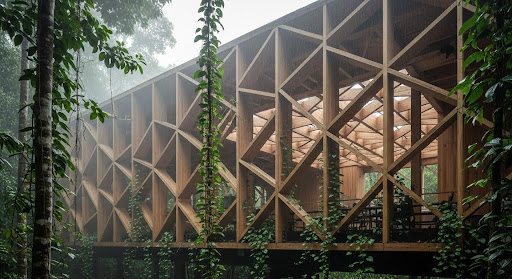
II. The Bio-Based Revolution: Building with Life
The most powerful solutions to our material crisis are not synthesized in a lab but grown in a forest or field. The bio-based revolution is about harnessing the innate intelligence of natural systems to create high-performance building materials that are renewable, scalable, and often carbon-negative.
Massive Timber Systems: The Wooden Skyscraper 🌲
Cross-Laminated Timber (CLT) and Glued-Laminated Timber (Glulam) are at the forefront of the mass timber movement. These engineered wood products offer the strength of steel and concrete but with a fraction of the carbon footprint.
- Material Properties:
- Strength: With load capacities ranging from 16-24 MPa for glulam and 15-25 MPa for CLT, these materials are more than capable of supporting mid- and high-rise structures.
- Thermal Performance: With a thermal conductivity of just 0.12-0.14 W/m·K, mass timber is a natural insulator, vastly outperforming concrete (1.4-2.0 W/m·K) and steel (50+ W/m·K). This inherent insulation reduces reliance on synthetic insulation materials and lowers operational energy needs.
- Hygroscopic Buffering: Timber naturally regulates indoor humidity by absorbing and releasing moisture. It can buffer its water content by 1-4% of its mass over a relative humidity range of 40-80%, helping to create a more stable and comfortable indoor environment without mechanical intervention.
- Fire Safety: Contrary to common misconceptions, mass timber performs exceptionally well in fires. The outer layer forms a protective char at a predictable rate of ~0.6 mm/minute, insulating the structural core. In standardized ASTM E119 fire tests, CLT panels have demonstrated 73-90 minutes of endurance, meeting the stringent 1-hour fire ratings required for many building types. This performance can be further enhanced with gypsum board protection.
- Construction Efficiency: Prefabricated mass timber panels can accelerate construction timelines by 30-50% and reduce on-site waste from a conventional 15-25% down to just 5-10%.
- Real-World Validation:
- Mjøstårnet (Brumunddal, Norway, 2019): At 18 stories, it was the world’s tallest wooden building upon completion, demonstrating the feasibility of timber high-rises. It achieved a 60% embodied carbon reduction and sources 100% of its timber from within a 500 km radius.
- Brock Commons (Vancouver, Canada, 2021): This 13-story student residence set a legal precedent for tall wood buildings in North America. Its hybrid CLT-concrete core design provides both seismic resilience and thermal mass, all while being built 40% faster and with 35% less waste than a conventional equivalent.
Hempcrete: The Carbon-Negative Insulator 🌱
Hempcrete is a non-load-bearing composite made from hemp hurd, lime binder, and water. Its unique properties make it a revolutionary material for insulation and building envelopes.
-
Material Properties:
-
Embodied Carbon: Hempcrete is unequivocally carbon-negative (-50 to -100 kg CO₂-eq/m³). The hemp plant absorbs more CO₂ during its rapid growth cycle than is emitted during the material’s production and application.
-
Thermal Performance: Its thermal conductivity of 0.06-0.10 W/m·K provides excellent insulation, 2-3 times better than conventional concrete.
-
Hygric Buffering: Hempcrete is a “breathable” material, capable of absorbing and releasing vast amounts of moisture (10-40 grams of water per gram of dry material over a 24-hour cycle). This superior performance helps regulate indoor humidity, preventing mold and creating healthier indoor environments, a feature validated for North American humid climates in a 2024 study.
-
Fire Performance: Hempcrete is highly fire-resistant. A 2025 Hempitecture certification confirmed its compliance with the ASTM E84 fire rating, a critical step for mainstream adoption.
-
Applications: Its lightweight nature (300-600 kg/m³) makes it ideal for internal insulation retrofits, light partition walls, and prefabricated panel systems, reducing the structural load on buildings.
Mycelium Composites: Grown from Waste 🍄
Mycelium, the root network of fungi, offers a radical new way to create materials. Grown on agricultural waste like rice bran or sugarcane bagasse, it forms a dense, lightweight, and fully compostable composite.
-
Manufacturing Process: The process involves a controlled growth period of 25-30 days under specific humidity (65-85% RH) and temperature (25-28°C) conditions, followed by heat treatment to stabilize the material.
-
Material Properties:
-
Thermal Performance: With a thermal conductivity of 0.04-0.045 W/m·K, mycelium is equivalent to EPS foam insulation but with a 2-3 times lower thermal diffusivity,
-
Embodied Carbon: As it is grown on waste products with minimal energy input, its embodied carbon is near-zero.
-
Challenges: The primary hurdles are mechanical durability, long-term moisture resistance, and cost. Current costs are around $500-800/m², with a target of $150-250/m² by 2030 to become competitive. Durability beyond 24 months is still being validated.
Bio-Cement: Self-Healing Concrete 🦠
Bio-cement represents a breakthrough in concrete technology. By embedding spore-forming bacteria (like Bacillus species) into the concrete matrix, the material gains the ability to heal itself.
-
Mechanism: When a microcrack forms and water enters, the dormant bacteria activate. They produce an enzyme that catalyzes the precipitation of calcium carbonate (limestone), effectively sealing the crack from within.
- Performance:
- Healing Capacity: Bio-cement can autonomously heal cracks up to 0.5 mm within 2-4 weeks.
- Service Life: This self-healing capability is projected to extend the service life of concrete structures by 15-25 years, drastically reducing maintenance and replacement costs.
- Embodied Carbon: At just 3-6 kg CO₂-eq/m³, it offers a 75% reduction compared to the binder in ordinary Portland cement.
- Market Status: Leading producers like BioMason and Prometheus Materials are already commercializing this technology. While currently costing $80-120/m³ (versus $40-60/m³ for OPC), costs are projected to fall to $50-80/m³ by 2027 as production scales.
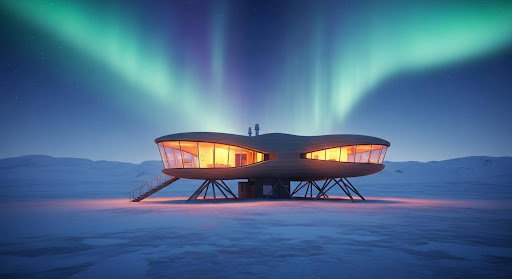
III. Climate-Specific Adaptation: Materials for a Changing World
A one-size-fits-all approach to building is no longer viable in a world of increasingly extreme and varied climates. The new material palette allows for hyper-local, climate-specific design strategies that enhance both resilience and comfort.
Arctic and Permafrost Regions: Foundations on Shifting Ground ❄️
In the Arctic, the primary design challenge is not just cold but the instability of thawing permafrost. Foundation failure is a critical risk.
-
Technology: Thermosyphons: These passive heat pipes are installed vertically through foundations. They work like a refrigerator for the ground, using a natural convective cycle to extract heat from the soil during the summer and radiate it into the cold winter air.
-
Performance & Economics: Over 200 buildings managed by Arctic Foundations Inc. have used thermosyphons to reduce ground temperatures by 3-5°C, limiting foundation settlement to less than 1 cm over 15 years. At a cost of $500-1,200 per unit, with a 50-year lifespan, the payback from avoided maintenance is significant. However, the documented cases of poor design leading to remediation costs of $500,000 to over $2,000,000 highlight the need for expert implementation.
-
Emerging Tech: Shape-Memory Alloy (SMA) Connectors: Currently in pilot deployments in Svalbard and Siberia, these advanced connectors can accommodate 1-10 cm of permafrost-induced settlement without structural failure, offering a new layer of adaptive resilience for a future with more aggressive thaw.
Hot-Dry and Desert Climates: Mastering the Diurnal Swing ☀️
In desert regions, the key is to manage the extreme temperature difference between day and night. The ancient strategy of thermal mass is being reinvented with modern materials and analysis.
- Strategy: Combine high thermal mass materials with passive design elements like external shading, courtyards, and windcatchers.
-
Materials: 50-80 cm thick rammed earth walls or stone provide exceptional thermal mass, absorbing the intense daytime heat and slowly releasing it during the cool night.
-
Performance: This strategy creates a 10–12-hour phase lag, meaning a 48°C daytime peak results in a comfortable 25-28°C interior temperature at night. This can reduce heating and cooling loads by 40-50%. Projects like the BEEAH Headquarters in Sharjah, with its central courtyard and optimized form, have achieved 20-30% cooling load reductions, while passive desert residences in the American Southwest have achieved 60-70% year-round passive comfort. The Liwa Farm Village in Abu Dhabi is projected to achieve a 45-55% annual energy reduction using these principles.
Tropical and High-Humidity Climates: Breathing Buildings 💧
In the tropics, the challenge is less about temperature and more about managing constant high humidity and the risk of flooding. Here, ventilation and moisture management are paramount.
- Strategy: Prioritize cross-ventilation, vapor-permeable membranes, and microclimate modulation through green infrastructure. Thermal mass is less effective here, with benefits often limited to under 10% energy reduction.
- Materials: Mass timber (CLT/glulam) is surprisingly effective. Its hygroscopic properties help buffer indoor humidity, while its lightweight nature is suitable for elevated, flood-resilient structures.
- Case Study: Kampung Admiralty (Singapore, 2019): This landmark project is a masterclass in tropical design.
- Its cross-shaped footprint is optimized for wind-driven cross-ventilation.
- An “egg-crate” facade provides a solar shading coefficient of 0.5-0.6 while enabling air circulation.
- The result: an energy use intensity of 70-80 kWh/m²/year (compared to a typical 120-140), with 80% thermal comfort satisfaction and indoor relative humidity maintained at 60-75% despite exterior swings up to 95%. This model has since been replicated in over a dozen projects across Southeast Asia.
IV. The Pathway to Scale: From Niche to Norm
The science is settled, and the pilot projects are successful. The final and most formidable challenge is scaling these material solutions from niche applications to the global mainstream. This requires a coordinated push across policy, finance, and industry.
Economic Barriers and Investment Dynamics 💰
The most significant hurdle is the 10-40% upfront cost premium for many climate-resilient materials. While life-cycle costs are often lower due to energy savings and durability, the initial capital expenditure remains a barrier for many developers. However, the market is beginning to shift:
- Carbon Pricing: The EU’s Emissions Trading System, which prices carbon at €80-100/tonne, and national carbon taxes like Canada’s (projected to hit $170 CAD/tonne by 2030) are systematically narrowing the cost gap between conventional and low-carbon materials by 5-10% per year.
- Capital Flows: ESG (Environmental, Social, and Governance) mandates are driving institutional investors toward climate-resilient properties. An estimated 15-20% more capital was available for green buildings from 2023-2025 compared to conventional projects.
- Market Premiums: Climate-resilient buildings already command a 3-8% price premium in North American and European markets, a signal of growing consumer and tenant demand.
- Supply Chain Investment: Recognizing the opportunity, investors poured $3-5 billion into new production capacity for these materials between 2020 and 2025, with projections for a $50-100 billion expansion by 2030.
Validated Performance: The Business Case for Green
Beyond emissions, these materials deliver tangible operational benefits that strengthen the business case. Field-validated data on Energy Use Intensity (EUI) shows consistent and significant reductions across building types and climates:
| Building Type / climate | Conventional EUI (kWh/m²/yr) |
Resilient Design EUI (kWh/m²/yr) |
Reduction |
|---|---|---|---|
| Office (Temperate) | 150-180 | 80-110 | 30-45% |
| Residential (Cold) | 180-220 | 90-130 | 35-50% |
| Office (Hot-Dry) | 200-250 | 100-140 | 40-50% |
| Tropical (Humid) | 120-140 | 70-85 | 30-40% |
These savings are driven by a synergistic combination of passive design (30-50% of the reduction), high-performance envelopes (15-25%), and optimized thermal mass (10-15%).
Regulatory Frameworks: Catching Up to the Technology ⚖️
Building codes have historically been slow to adapt, but momentum is building.
-
North America: The 2021 International Building Code (IBC) officially legalized the use of CLT in tall buildings, a landmark decision that has unlocked a wave of mass timber projects.
-
Europe: The EU is moving toward mandating low-carbon materials through requirements for Environmental Product Declarations (EPDs) and is expected to introduce firm embodied carbon limits between 2025 and 2030.
-
Hempcrete Certification: In 2025, hempcrete achieved crucial ASTM E84 fire rating certification in the U.S., a major step toward mainstream acceptance.
More Case Studies: The Global Movement
The theoretical has become practical. A growing portfolio of world-class buildings serves as a real-world testament to this material revolution.
-
INTRO (Vienna, Austria, 2022): This 11-story residential building utilized over 7,000 m³ of black spruce CLT. With a strategy combining external insulation with internal CLT thermal mass, it achieves an impressive operational carbon footprint of just 25 kg CO₂-eq/m²/year.
-
Origine (Quebec City, Canada, 2023): A 13-story, all-timber building that validates mass timber’s performance in harsh cold climates. Its use of black spruce CLT for all load-bearing elements contributes to a 5-15% heating load reduction even in -20 to -30°C winters.
-
T3 Bayside (Melbourne, Australia, 2023): A 12-story office building showcasing biophilic design with exposed mass timber interiors. It achieved a 35% embodied carbon reduction and premium certifications (LEED Gold, WiredScore Platinum), highlighting the link between sustainability and high-value commercial real estate.
Conclusion: A New Foundation for the Future
The narrative that sustainable building is a niche luxury, a compromise on performance, or a distant future possibility is now definitively obsolete. The evidence from hundreds of real-world projects is unequivocal: we have the materials to build a climate-resilient, low-carbon, and even carbon-negative built environment right now.
The numbers tell the story:
- 40% of global emissions are tied to buildings, with 11% locked in materials.
- New materials offer 21-95% embodied carbon reductions and 13-50% operational energy savings.
-
Bio-based materials like hempcrete and mycelium are demonstrating that construction can be a tool for carbon sequestration, not just emission.
From the fire-resistant strength of a CLT skyscraper to the self-healing intelligence of bio-cement and the breathable comfort of a hempcrete wall, the solutions are elegant, effective, and ready to be deployed.
The obstacles we face are no longer technical; they are systemic. They lie in outdated regulations, misaligned financial incentives, and underdeveloped supply chains. Overcoming them does not require an invention, but rather a new collective resolve.
The path forward demands three concurrent actions:
- Mandate Change: Policymakers must accelerate code reform and use tools like carbon pricing to make the true cost of conventional materials impossible to ignore.
- Finance the Transition: Investors must look beyond upfront cost to price in the long-term value of resilience and the growing risk of carbon-intensive assets.
-
Build the Ecosystem: Industry must invest aggressively in supply chain capacity and the workforce skills needed to make these new materials the default standard.
We are standing at a pivotal moment. We can continue to build with the materials of the 20th century and lock in a future of climate instability, or we can embrace the material revolution and begin building a world that is not just resilient, but truly regenerative.
The foundation for that future is already laid. It is time to build upon it. 🌍🏗️⚡